Appinio Research · 21.05.2026 · 11min read
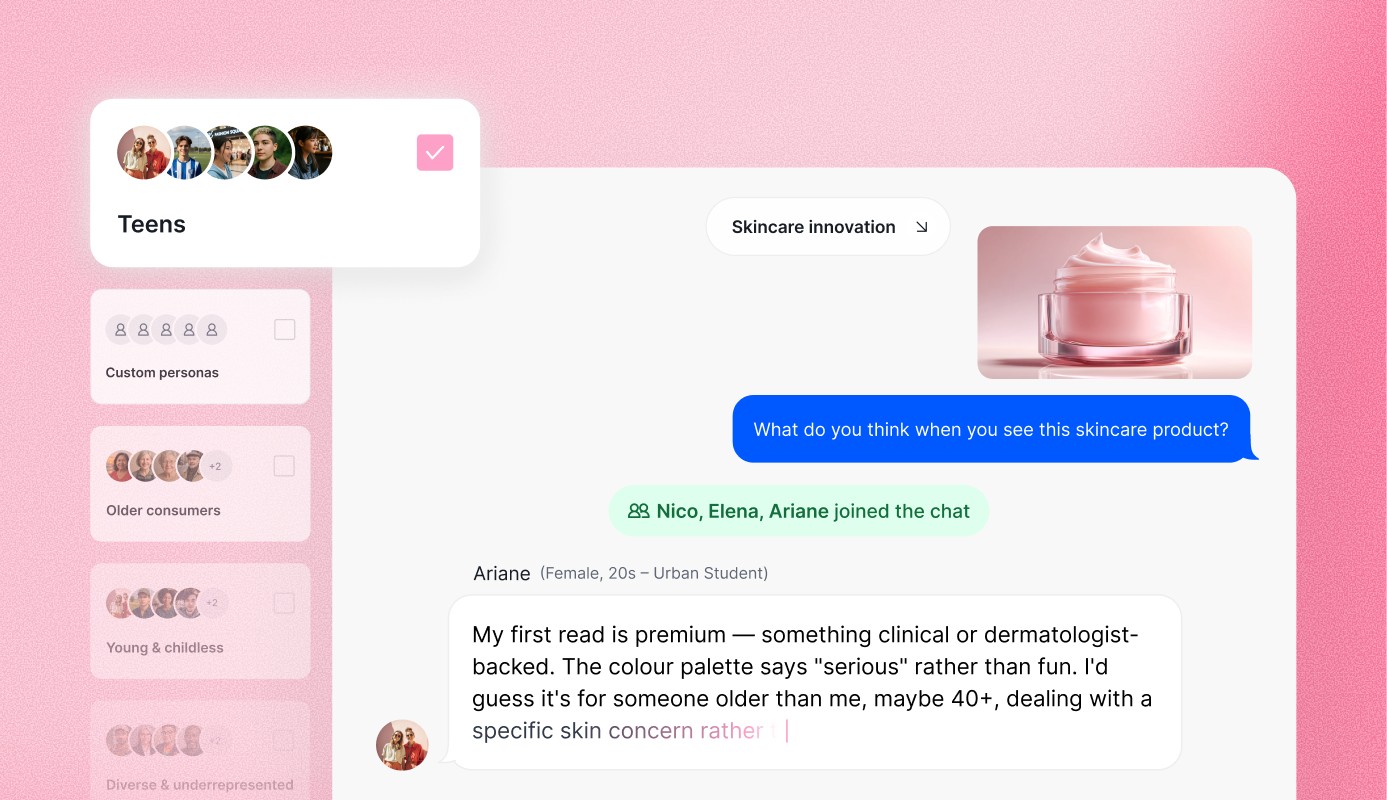
Synthetic personas are built for the exploratory phase of your research. Think of it as a smart digital focus group that scales. It gives you direct access to consumer voices – their language, their emotions, their reasoning – before you’ve locked in your survey logic.
The golden rule: Use synthetic personas in the discovery and ideation phase, or in post-research deep-dives. It is not a replacement for quantitative or qualitative research – it’s the layer that makes your quant research sharper, smarter, and more relevant.
The key distinction: synthetic personas explore attitudes, behaviours, trends, and motivations. It is not a tool for measuring awareness, definitions, or frequencies. Those belong in a survey.
The AI behind synthetic personas is designed to give you nuanced answers, but only if you ask it the right questions.
Where synthetic personas fit in your research workflow
Think of it as the first step in a two-stage research process:
|
Stage 1: Synthetic personas (with Appinio Conversations |
Stage 2: Appinio Survey |
|
Explore: What sentiments do consumers have? What associations do they make? What themes come up? |
Validate: How many feel this way? |
|
Uncover motivations, tensions, needs and barriers |
Measure, rank, compare |
|
Help formulate your hypotheses and structure your questionnaire |
Validate or reject your hypotheses with statistical confidence |
|
Open-ended, conversational |
Structured, scalable |
Insights from synthetic personas inform better surveys. Better surveys generate more actionable data. The two tools work best together.
Best practices: How to ask great questions
Think behaviour and attitude, not awareness
Synthetic personas are not a search engine. Don’t ask it to measure whether people know about something – the AI will search for official definitions and return dry, factual answers that tell you nothing about how real people feel.
Awareness and definitions belong in a quantitative survey. It's is where you go to understand attitudes, motivations, and behaviours.
|
Instead of this... |
Try this |
|
❌ Have you heard of kombucha before? |
✅ What do you think of kombucha? What draws you to it, or puts you off? |
|
❌ What is sustainable packaging? |
✅ Are you looking for sustainable packaging? Why is it important to you? What do you pay attention to? |
|
❌ Do you know Brand X? |
✅ You mentioned you shop for sports gear regularly – where does Brand X fit into that, if at all? |
Bake context into your first message
If you want respondents to reflect on something specific – a category, a brand, a trend – introduce it in your opening question. Don’t ask about awareness first and then try to pivot. By the time you follow up, the AI-generated response will already be flavoured by a generic answer.
When you introduce the topic alongside a genuine attitudinal question, you get richer, more honest, more useful answers from the start.
Rule of thumb: If your question can be answered with a simple yes or no, it’s not ready for Conversations yet. Reframe it to invite behaviour, opinion, or experience.
Ask open questions
Every question you design for synthetic personas should be genuinely open-ended. Closed questions – even ones that seem exploratory – constrain the response. You miss the texture, the nuance, and the unexpected connections that make qualitative research valuable.
Instead of “Do you prefer X or Y?”, try “When you’re choosing between X and Y, what goes through your mind?”
Don’t lead the witness
Avoid framing your questions in ways that imply a preferred answer. This is the research equivalent of leading the witness. If your question signals what you want to hear, you will hear it back – and it won’t be useful.
|
Instead of this... |
Try this |
|
❌ Don’t you think sustainability is important? |
✅ How, if at all, does sustainability factor into your purchasing decisions? |
|
❌ What do you love about our new pack design? |
✅ When you first saw this pack design, what went through your mind? |
|
❌ Wouldn’t you switch brands for a better price? |
✅ Walk me through the last time you considered switching brands. What was going through your head? |
Avoid implying judgement
Questions that imply judgement – either of the persona’s choices or of the topic at hand – trigger defensive responses. You stop getting honest answers and start getting socially acceptable ones. Keep your questions neutral in tone.
Reference earlier answers: hold contradictions to account
Like a skilled moderator in a real focus group, you can call out contradictions and push for clarity.
If a respondent said they care about sustainability early in the conversation, but later describes a purchasing decision that suggests otherwise, probe it. Ask them to reconcile the two. This is where the real insight lives.
Focus group mindset: Good qualitative research is not passive. It listens, it probes, it follows threads. Treat synthetic personas the same way you’d treat a well-run focus group – with curiosity, follow-up, and no leading.
Dos and Don’ts at a glance
|
✅ Do |
❌ Don’t |
|
Use it in the ideation and exploration phase |
Use it to replace quantitative research |
|
Ask open questions that invite opinion and attitude |
Ask closed yes/no questions |
|
Introduce context in your opening question |
Ask about awareness in isolation first |
|
Follow up on contradictions and probe deeper |
Accept vague answers at face value |
|
Keep questions neutral and judgement-free |
Imply the answer you want to hear |
|
Use consumer language from Conversations in your survey design |
Skip straight to quant without exploring first |
|
Think of it as a digital focus group |
Think of it as a search engine or fact-checker |
Getting started: A quick-start checklist
Before you launch your next synthetic personas chat, run through this list:
- Define your research objective. What decision does this insight need to support?
- Confirm you’re in exploration mode. If you need to measure, use a survey. If you need to discover, explore, or understand, use synthetic personas with Appinio Conversations.
- Write your opening question. Make sure it’s open, neutral, and introduces both context and an attitudinal hook.
- Think of probing questions as you go. What follow-ups will help you go deeper on the most important themes?
- Check for leading language. Remove anything that implies a preferred answer or passes judgement.
- Decide how you’ll use the outputs. Will you use consumer language for survey design? Generate hypotheses for a quant study? Inform a brief?
Appinio Conversations gives you something traditional research rarely delivers quickly: the real words, real reasoning, and real motivations behind consumer behaviour. But it works best when you approach it like a researcher - with curiosity, precision, and the willingness to dig.
Ask open questions. Introduce context early. Challenge contradictions. And always remember: this is your exploratory layer, not your final answer.