The 6 best Brand Trackers: Which one actually measures your Brand's Health?
Appinio Research · 04.08.2026 · 20min read
Content
Every marketer knows the feeling. The campaign is live, the budget is spent, and then someone in the leadership meeting asks the question: "So… is our brand actually getting stronger?"
It sounds like a simple question. It isn't. Because "brand tracking" has become an umbrella term for wildly different things. Some tools track how visible your brand is on Google. Others monitor what people say about you on social media. Others survey real consumers about what they think and feel. The newest generation goes one step further, measuring whether your brand actually comes to mind in the moments that lead to a purchase.
All of these tools call themselves brand trackers. But they answer fundamentally different questions.
In this article, we compare six of the most talked-about brand tracking solutions — Appinio, Ahrefs, SEMrush, Google Search Console, Brandwatch, and YouGov — across three dimensions: their main objective, what makes them stand out, and who they're best suited for. By the end, you'll know exactly which tracker (or combination of trackers) fits your brand's stage, budget, and burning questions.
First, a quick reality check: not all "brand tracking" is created equal
Before we dive into the list, it helps to understand the three broad families these tools fall into:
Search-based trackers (Ahrefs, SEMrush, Google Search Console) measure your brand's digital footprint: branded search volume, share of voice in search results, backlinks, and mentions across the web. They tell you how discoverable your brand is.
Social listening trackers (Brandwatch) monitor conversations happening about your brand across social media, forums, news, and review sites. They tell you what people are saying — the volume, sentiment, and topics of the conversation.
Survey-based trackers (YouGov, Appinio) go directly to consumers and ask. They tell you what people actually think, feel, and remember — including the silent majority who never tweet about your brand or type it into Google.
Here's the catch: search and social data only capture people who are already actively engaging with your brand. But most of your future customers aren't doing that today. They're going about their lives, and the real battle is whether your brand surfaces in their memory when a relevant buying situation comes up. That's why survey-based tracking — and especially the modern Mental Availability approach — plays in a different league when the question is genuine brand health.
Let's get into the list.
1. Appinio — Brand Health Tracking built on Mental Availability
Main objective: Measure how likely your brand is to come to mind in real buying situations — and track how that evolves over time against your competitors.
Appinio is a real-time market research platform that lets brands run continuous brand health tracking with real consumers in over 90 markets. What sets its brand tracker apart is the methodology at its core: Mental Availability, the framework developed by the Ehrenberg-Bass Institute (Byron Sharp's How Brands Grow and Jenni Romaniuk's Better Brand Health) and widely regarded as the most evidence-backed approach to brand growth in modern marketing science.
Traditional brand trackers rely on the classic AIDA funnel: aided and unaided awareness, consideration, preference, NPS. These metrics have two well-documented problems. For big brands, they plateau — once you hit 90% aided awareness, the tracker stops telling you anything new. For challenger brands, they're distorted by the halo effect of category giants, making it nearly impossible to see real progress.
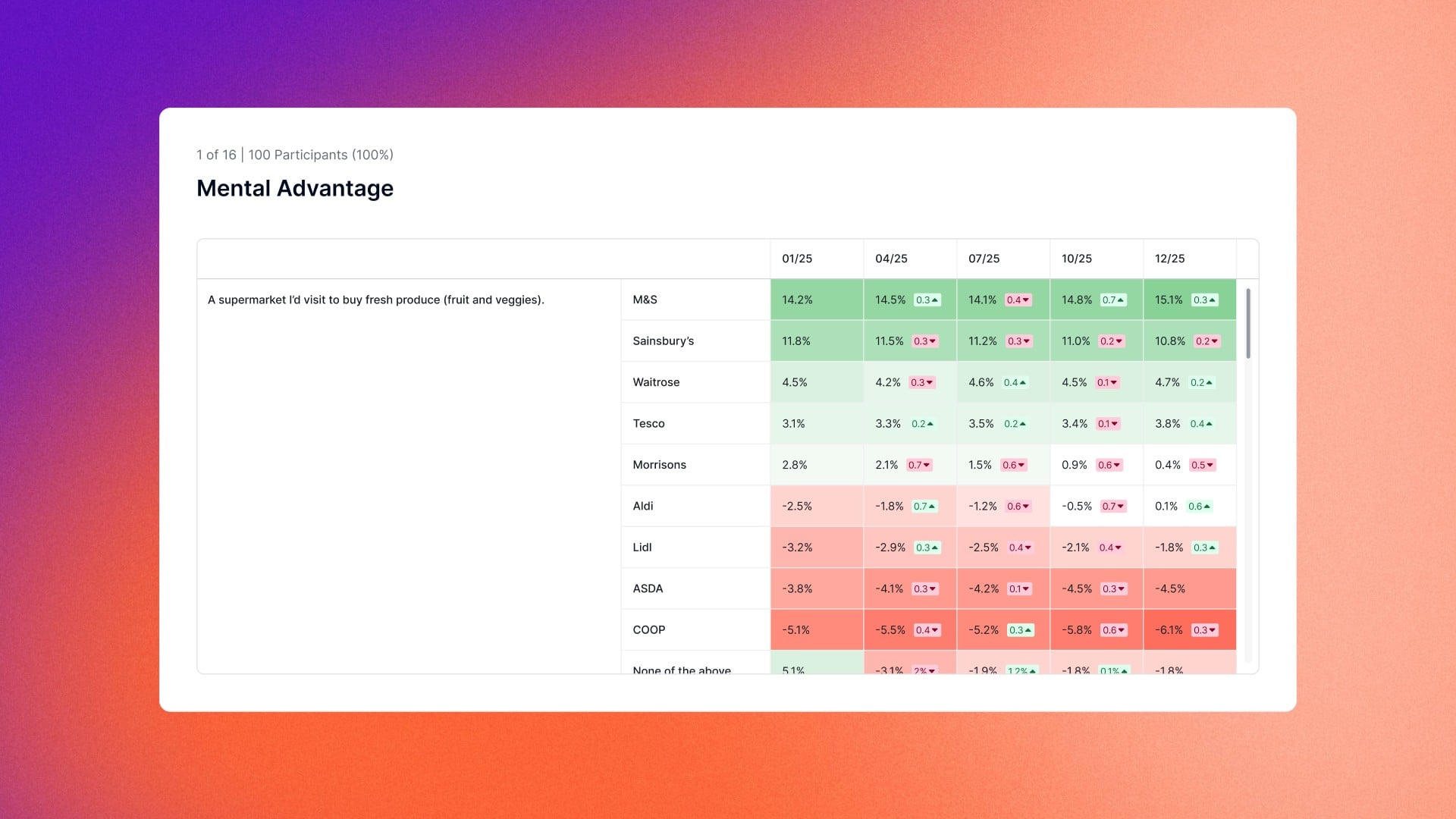
Mental Availability solves both problems by shifting the question. Instead of asking "Do you know brand X?", it asks: "In this specific buying situation — a Category Entry Point (CEP) — which brands come to mind?" Think "a beer for after sports," "a snack for a road trip," or "a bank for my first mortgage." A brand's health is the breadth and strength of these memory links, captured through four core KPIs:
- Mental Penetration (MPen): the share of category buyers who link your brand to at least one CEP — like awareness, but less biased toward big brands.
- Network Size: the average number of CEPs associated with your brand — the richness of your memory network.
- Mental Market Share (MMS): your brand's share of all brand-CEP associations in the category — strongly correlated with actual market share.
- Share of Mind: your mental strength among people who already know your brand.
What makes it stand out:
- Predictive, not just descriptive. Because Mental Market Share correlates strongly with real market share, the tracker doesn't just describe your brand's past — it points to where revenue is heading and which specific buying situations you're losing.
- Actionable by design. When a classic tracker tells you unaided awareness dropped two points, what do you do with that? When a Mental Availability tracker tells you you're losing the "quick weekday dinner" CEP to a specific competitor, you know exactly what your next campaign should say.
- Speed and agility. Appinio's global consumer panel delivers results in hours, not weeks, with interactive dashboards, flexible audience splits, and tracking waves you control — plus support from in-house research experts to set up the study correctly.
- Full research platform behind it. Brand tracking rarely lives alone. On the same platform you can run campaign pre-tests, ad creative tests, pricing research, and target group analyses — closing the loop between measuring brand health and acting on it.
Best suited for: Brand, insights, and marketing teams at consumer-facing companies who need to prove and improve real brand health — especially challenger brands that get flattened by classic awareness metrics, and established brands whose funnel KPIs have plateaued. If your leadership asks "is our marketing actually building the brand?", this is the category of tool that can answer.
Limitations: As a survey-based tracker, it won't monitor your backlink profile or scrape social conversations — that's simply a different job. Many teams pair a Mental Availability tracker with an SEO or social listening tool.
2. YouGov — syndicated brand tracking at massive scale
Main objective: Provide continuous, syndicated brand perception data across thousands of brands and dozens of markets.
YouGov is one of the most established names in survey-based brand tracking. Its flagship product, YouGov BrandIndex, interviews consumers daily and tracks thousands of brands across sectors and countries on a standard set of metrics: awareness, buzz, impression, quality, value, reputation, satisfaction, recommendation, consideration, and purchase intent.
What makes it stand out:
- Historical depth and daily cadence. Because YouGov has been fielding the same questions for years, you can benchmark your brand against long-running trend lines and see, almost in real time, how a PR crisis or a big campaign moves public perception.
- Syndicated competitive data. Your competitors are already in the dataset. You don't need to design a study — you subscribe and start comparing.
- Broad audience profiling. YouGov's connected panel data lets you slice brand metrics by rich demographic and attitudinal profiles.
Best suited for: Large enterprises and agencies that want always-on, standardized perception benchmarking across many brands and markets, and that value historical trend data over customization.
Limitations: The strength of syndication is also its constraint. The metrics are largely fixed, funnel-style KPIs — awareness, consideration, buzz — which suffer from the ceiling and halo effects described above. You typically can't tailor the study to your category's actual buying situations, your specific competitor set beyond what's covered, or your own research questions. It tells you how you're perceived; it's less equipped to tell you whether you'll be retrieved from memory when it counts or what to do next. Pricing is also firmly enterprise-level.
3. Brandwatch — social listening as a brand health proxy
Main objective: Monitor and analyze what's being said about your brand across social media, news, blogs, forums, and review sites.
Brandwatch (part of Cision) is one of the leading consumer intelligence and social listening platforms. It ingests billions of online conversations and applies AI-driven analysis to surface mention volume, sentiment, trending topics, share of voice, and emerging crises around your brand and competitors.
What makes it stand out:
- Unmatched conversational coverage. If it's said publicly online, Brandwatch can probably find it — including historical data going back years.
- Real-time crisis detection. Spikes in negative sentiment show up within hours, making it invaluable for PR and comms teams.
- AI-powered analysis. Image recognition, sentiment analysis, and trend detection help teams cut through enormous volumes of unstructured chatter.
Best suited for: PR, communications, and social media teams at organizations with significant public conversation around their brand — companies that need to manage reputation, spot crises early, and understand cultural trends.
Limitations: Social listening measures the loud minority. The people posting about your brand are a small, systematically unrepresentative slice of your market — skewed toward the very engaged, the very angry, and the very online. The silent majority of category buyers, whose memories actually determine your future sales, are invisible to it. Sentiment analysis also remains imperfect with sarcasm and context. Brandwatch tells you about the conversation around your brand, not the cognition behind purchase decisions — a crucial distinction when the goal is brand health.
4. SEMrush — brand visibility through the lens of search and digital marketing
Main objective: Track your brand's visibility and performance across search engines and digital channels.
SEMrush is best known as an all-in-one digital marketing suite — SEO, PPC, content, and competitive research. For brand tracking specifically, it offers branded search volume tracking, position tracking for brand keywords, brand monitoring for online mentions, and share-of-voice analysis in search results.
What makes it stand out:
- Breadth of the toolkit. Few platforms combine keyword research, rank tracking, backlink analysis, advertising intelligence, and brand mention monitoring in one place.
- Competitive digital intelligence. You can estimate competitors' traffic, top keywords, and ad strategies — useful context for your brand's digital footprint.
- Branded search as a demand signal. Growth in people googling your brand name is a genuine (if indirect) indicator that brand-building activity is working.
Best suited for: Digital marketing and SEO teams who want to quantify their brand's online visibility, monitor branded search demand, and keep an eye on competitors' digital strategies — all within the toolkit they already use daily.
Limitations: SEMrush measures behavior at the very bottom of the brand-building chain: people who already remembered you and typed your name into a search bar. It can't tell you why branded search is flat, which consumer segments don't think of you, or which buying situations you're absent from. Branded search volume is a lagging thermometer of brand health, not a diagnosis.
5. Ahrefs — the SEO specialist's view of brand presence
Main objective: Measure your brand's authority and visibility in organic search — backlinks, keywords, and web mentions.
Ahrefs is widely considered the gold standard for backlink analysis and one of the strongest SEO toolsets on the market. From a brand tracking perspective, it lets you monitor branded keyword volumes and rankings, track new backlinks and unlinked brand mentions across the web, and benchmark your site's authority against competitors.
What makes it stand out:
- Best-in-class link index. Ahrefs' crawler and backlink database are among the largest in the industry, giving an exceptionally detailed picture of who references your brand online.
- Clean, focused UX. Compared with broader suites, Ahrefs is known for doing SEO deeply and doing it well.
- Content and mention discovery. Content Explorer surfaces where your brand (or your competitors) are being talked about in published web content — useful for digital PR.
Best suited for: SEO professionals, content marketers, and digital PR teams who equate brand strength with search authority and want the sharpest possible view of their organic footprint.
Limitations: Like SEMrush, Ahrefs observes digital shadows of brand strength rather than brand strength itself. A brand can dominate backlinks and still be losing mental ground in its category — or vice versa. There's noconsumer voice in the data, no perception, no memory, no purchase intent.
6. Google Search Console — the free pulse check on branded demand
Main objective: Shows you exactly how your website performs in Google Search — including how often people search for your brand and click through.
Google Search Console (GSC) isn't a brand tracker in any formal sense, but it deserves a place on this list because it's free, it's first-party data straight from Google, and nearly every marketing team already has it. For brand purposes, its value lies in tracking impressions and clicks for branded queries over time.
What makes it stand out:
- It's free and it's the source of truth. No estimates, no third-party modeling — this is Google's own data on your queries, impressions, clicks, and rankings.
- A clean signal of branded demand. A steady rise in branded impressions is one of the simplest indicators that more people are actively looking for you.
- Zero setup cost. If you have a website, you can start today.
Best suited for: Startups, small businesses, and any team that wants a free, directional read on whether brand-building efforts are translating into search demand — or a sanity check alongside paid tools.
Limitations: GSC only sees your own website's performance on Google. No competitor data, no perception data, no social data, no consumer voice. It's a thermometer strapped to one channel — useful, but nobody should mistake it for a brand health tracker.
Side-by-side: how the six trackers compare
|
Tool |
What it measures |
Data source |
Competitor view |
Consumer voice |
Best for |
|
Appinio |
Mental Availability, brand health KPIs, perception |
Consumer surveys (real-time panel) |
Yes — full competitive CEP mapping |
Yes — representative |
Brand & insights teams measuring and growing real brand health |
|
YouGov |
Perception & funnel metrics (buzz, consideration, etc.) |
Daily syndicated surveys |
Yes — syndicated |
Yes |
Enterprises wanting standardized, always-on benchmarking |
|
Brandwatch |
Mentions, sentiment, share of voice |
Social & web listening |
Yes |
No — only the vocal minority |
PR & comms teams managing reputation and crises |
|
SEMrush |
Search visibility, branded search, mentions |
Search & clickstream data |
Yes — digital only |
No |
Digital marketing teams tracking online visibility |
|
Ahrefs |
Backlinks, branded keywords, web mentions |
Web crawl & search data |
Yes — digital only |
No |
SEO & digital PR specialists |
|
Google Search Console |
Branded impressions & clicks on Google |
Google first-party data |
No |
No |
Anyone wanting a free read on branded search demand |
So which brand tracker should you choose?
The honest answer: it depends on the question you're trying to answer.
If your question is "How visible are we online?" — Ahrefs, SEMrush, or (for free) Google Search Console will serve you well.
If your question is "What are people saying about us right now?" — Brandwatch is built exactly for that.
If your question is "How do we benchmark against thousands of brands on standard perception metrics?" — YouGov's syndicated data is hard to beat for breadth.
But if your question is the one that actually determines your future revenue — "Will consumers think of us in the moments that matter, and how do we make sure they do?" — then only a survey-based tracker built on Mental Availability can answer it. Search data and social chatter are downstream symptoms of brand health. Memory structures in consumers' minds are the cause. Appinio's brand health tracking measures the cause: which Category Entry Points you own, which you're losing, and to whom — with the speed and flexibility to act on it before the next quarterly review.
Many of the strongest brand teams we work with combine tools: GSC or SEMrush for the digital pulse, perhaps a listening tool for PR, and a Mental Availability tracker as the strategic backbone that everything else reports into.
Ready to see how mentally available your brand really is?
Talk to our research experts and set up a brand health tracker built on the science of how brands actually grow.
or
to build your first survey in seconds and uncover the insights that really matter!
Get facts and figures 🧠
Want to see more data insights? Our reports are just the right thing for you!