Appinio x Basel Tourism
Mental availability as a new compass for destination brands
The back story: How a podcast sparked a project
The foundations for this pioneering project were laid when Dominic Stöcklin, CMO of Basel Tourismus, listened to an episode of Charles & Charlotte's podcast with Appinio. The concept of Mental Availability fascinated him so much that he began to revisit the foundational scientific works on marketing research.
Stöcklin already knew Appinio from a previous role at Switzerland Tourism, where he ran agile brand lift studies. Familiar with Appinio's speed and rigour, the decision was made: the classic Mental Availability framework – originally developed for consumer goods – would be adapted for destination branding, in partnership with Appinio.
Brand industry
Travel & Hospitality
Markets
Germany & Switzerland
Scope
45 targeted questions
Target group
City travelers
Setup & frequency
Pre-Study & Semi-Annual Tracking per country
Participants
N=5,000 respondents
The challenge: The "overnight stays dead end" in tourism marketing
Traditionally, the tourism industry has measured the success of its marketing activities almost exclusively through downstream, retrospective KPIs, such as overnight stays or bed occupancy. For modern, future-oriented marketing, this method falls short: it only shows who has already been there. It doesn't reflect the actual brand impact at the top of the marketing funnel – the question of how a city is anchored in people's minds before a trip is planned.
Basel Tourism needed to measure how readily and how often the destination surfaced in potential travellers' minds across its core markets, for specific travel occasions. The aim was a fundamental shift away from gut-driven decisions and towards a completely analytical, data-supported funnel management system.

The Appinio solution: new methodological territory - "From the refrigerated shelf to the destination"
In order to decipher brand presence in the city break category with scientific precision, Appinio adapted the classic Mental Availability framework to the needs of a tourism organization:
-
The brands: instead of consumer goods, Basel and around 25 European benchmark cities (including Zurich, Geneva, Hamburg, Vienna, Barcelona, Amsterdam) were analyzed.
-
The Category Entry Points (CEPs): Classic purchase occasions were translated into specific travel occasions. Even at this stage, a key finding emerged: seemingly minor factors carry surprising weight – for instance, "Weekend trip with a comfortable train journey" or "A relaxed cultural city without the crowds."
-
The target group design: Instead of rigidly focusing on the existing, narrow personas, a broad "category user" was defined – city travellers aged 18-65. Core personas were mapped using smart quotas, while keeping the study open open to surface undiscovered growth potential.
The two-stage research approach:
- The pre-study: Testing a longlist of 50-60 potential CEPs to mathematically weight the 20 or so most strategically relevant travel occasions in isolation.
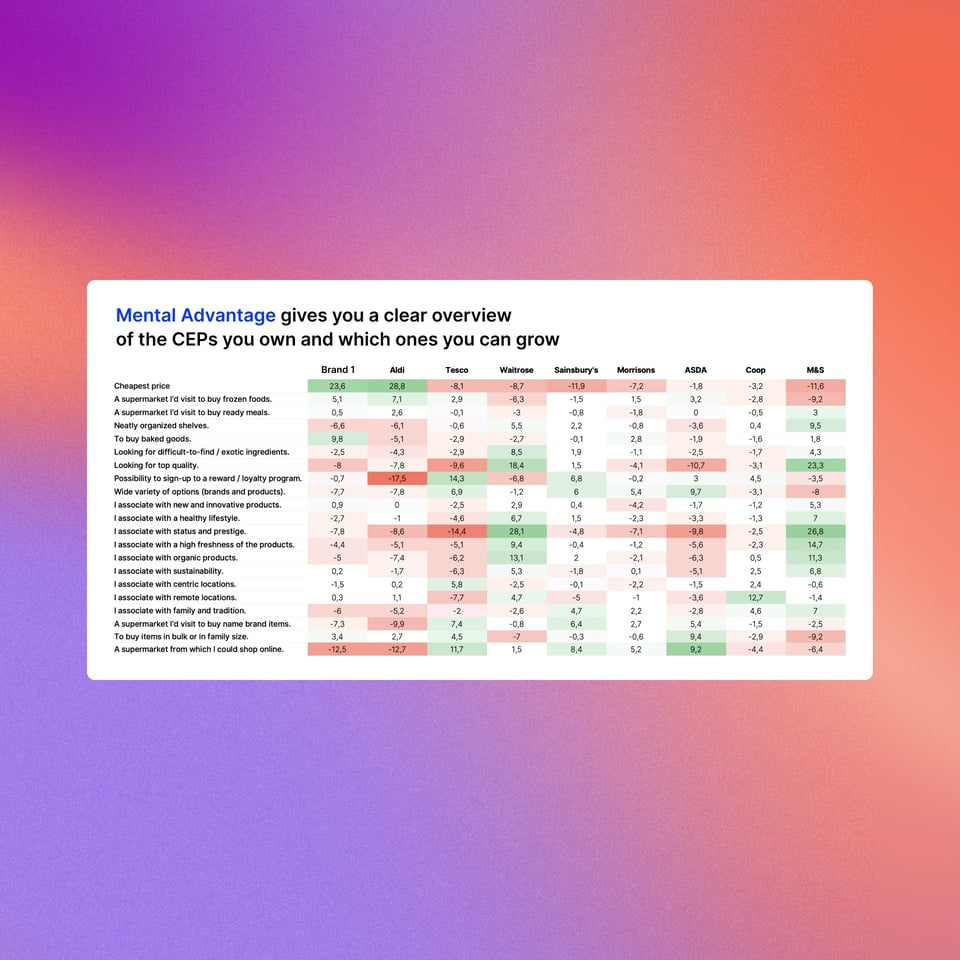
- The main study (tracking): A platform-based online study tracking core KPIs over several waves calculated (Mental Penetration, Network Size, Mental Market Share and Share of Mind). The output is not a rigid 100-page report, but an interactive, visual Mental Advantage Map (heatmap) in real time.
"The biggest scientific challenge was to neatly transfer a framework that was actually developed for FMCG products on supermarket shelves to the highly complex customer journey in tourism."
Constanze Lejeune
Senior Research Consultant
"A destination is not an impulse purchase. Through our two-stage approach, we were able to mathematically isolate people's subconscious reasons for traveling - the category entry points. The resulting Mental Advantage Map now provides Basel Tourism with unprecedented visual clarity about which mental nodes they need to occupy in the minds of the target group in order to stand out from the competition in the long term."
The most important strategic insights
The tracking revealed in-depth, qualitative findings that now serve Basel Tourism as a direct basis for action:
-
Positioning as a human and valuable alternative
-
Addressing internal concerns about price levels
-
Germans appreciate the relaxed city of culture
- The home market (Switzerland) - The accessible premium alternative:
In Switzerland, Basel has an outstanding, functional base – highly efficient rail connectivity, safety, cleanliness. But the brand struggles to differentiate itself emotionally compared to the strongest domestic benchmark, Zurich. The heatmap revealed a huge opportunity: as Zurich falls behind in terms of welcome culture and value for money, Basel can position itself as the human, high-quality, approachable alternative. - The growth market (Germany) - The relaxed cultural niche:
In Germany, the dynamic is reversed. Basel does not win here on scale, but scores points as the "relaxed cultural city without mass tourism". German travellers appreciate the inspiring atmosphere, architectural experience and stress-free accessibility. - The "value for money" myth check: A central learning cleared up internal fears: for German city travellers, Basel's price-performance ratio is almost completely neutral. The Swiss price level is therefore not a hard barrier as long as the expected high quality and reliability are delivered.
Our story
"As a tourism organization, we don't market a product on the refrigerated shelf, but an entire city. But in the end, it's about exactly the same thing: mental and physical availability.
Appinio's Mental Availability Tracking helps us enormously in answering the question of how we want to do marketing, with which messages and which niches we need to focus on."
Dominic Stöcklin
CMO & Deputy CEO, Basel Tourism
Best practice: Bringing data to life
Introducing a new scientific concept like Mental Availability into an organisation requires clear internal change management. Basel Tourism built a three-stage process for exactly this:
- The reading assignment: prior to meetings, the marketing team received targeted reading build a shared understanding of the theory behind Mental Availability.
- The cross-departmental presentation: In the bi-weekly Marketing Bi-Weekly, the basic key insights and data structures were presented for all to understand.
- The lead workshops: The results were brought into the management team. The marketing lead then filtered the data in detail in order to answer the key questions: What does this mean for us specifically and how do we need to change our campaigns?
The collaboration with Appinio
Methodological depth mattered, but so did operational relief. With limited internal resources and in-depth market research expertise, the Appinio research team acted as an intensive sparring partner. The combination of intuitive technology and human guidance at eye level allowed Basel Tourism to turn complex data matrices into actionable decisions, without heavy internal effort.
"We simply don't have the resources and in-depth market research knowledge internally. We need a partner who thinks along with us intensively. Appinio's agile approach is extremely exciting because it enables organizations like us to conduct modern market research in the first place. That wasn't even conceivable before." -Dominic Stöcklin, CMO & Deputy CEO, Basel Tourism
The next strategic steps
Basel Tourism is using the findings of the first wave to fundamentally evolve its marketing:
- Focus on messages that appeal to the masses: trivial but crucial CEPs such as accessibility are being elevated to high priority.
- Strategic transportation collaborations: Cross-media campaigns with major European rail transportation partners (Deutsche Bahn, SBB, TGV, Trenitalia) to stage Basel as a perfectly accessible hub ("The Gateway to Switzerland") are being explored.
- International scaling: Biannual tracking across Germany and Switzerland will become a fixed, data-driven compass. Expansion into additional strategic markets is planned from next year.
"The tourism industry has always measured success retrospectively in terms of overnight stays. But that only shows us the past. With Appinio, we measure our brand impact at the very front of the funnel - exactly where the travel decision is made in the mind. Seeing that the price-performance ratio is not an insurmountable barrier in the German market takes enormous pressure off our communication."
Dominic Stöcklin, CMO & Deputy CEO, Basel Tourism
For us at Appinio, the work doesn't stop at providing data. Our goal is to translate complex scientific frameworks like Mental Availability to deliver real actionable insights for the accompanying team from day one.
Working in close partnership with Dominic and his team has shown how we can perfectly compensate for a lack of internal market research resources through agile, technology-enabled consulting
Maren Genath
Customer Success Manager, Appinio
Any more examples?

Case Study
About You shapes its communication
Read more
Case Study
Product development through consumer feedback
Read more
Reviews
What our customers say about us
If our NPS of 85 is not yet convincing - that's what our customers say. Because: speed and quality are not contradictory. Our customers appreciate both.
Read more