Appinio Research · 12.11.2026 · 17min read

Most market research platforms can put a survey in front of respondents. That is not where they differ.
They differ on where those consumers come from, what you have to commit to before you start, and what kind of research methods can be offered on a high quality scale. Those three things decide most of what you pay and most of what your data is worth.
This guide sets out the questions worth asking any provider, what varies across the market, and how Appinio answers them. Ask the same questions of everyone you shortlist and the differences become obvious quickly.
At a glance
|
What to ask |
Why it matters |
How Appinio answers it |
|---|---|---|
|
Who checks my questionnaire before it fields? |
A leading screener or a missing quota cannot be fixed after fieldwork |
A research consultant reviews every study, including self-serve ones. |
|
Where do the respondents come from? |
Decides speed, accountability for data quality, and whether you can re-contact people |
Our own app-based panel and our partner panel network, reach over 100m people |
|
How long until I have results? |
Determines whether research fits inside a decision or arrives after it |
Every project is different and the field time varies a lot depending on broad vs. niche audience and sample size as well as target market. |
|
What do I commit to before I start? |
Licences and expiring credits cost you in months you do not research |
Pay per survey or buy bigger project packages (with credits). No licence fee |
|
What sits outside the package? |
A low base rate stops being low once design, cleaning and reporting are billed separately |
Expert guidance is included, not quoted as a separate service |
|
Which methods can I actually run? |
Basic tools cover awareness studies but not pricing, trade-offs or segmentation |
Conjoint, MaxDiff, U&A, brand tracking, Concept and Creative testing, Pricing analysis, Psychographic segmentation and more can be done with Research Consultant support |
How easy is the survey set-up?
Ease of set-up varies more than almost anything else in this market, and it varies in two directions rather than one.
At one end sit enterprise platforms built for maximum flexibility. They can build almost any survey you can design, and that same flexibility is why they take the longest to learn. Teams running them usually have trained researchers who are able to implement highly advanced method set-ups. At the other end sit heavily templated tools. You pick a standardized study type and fill it in, which is very fast when your research fits the template and a dead end when it does not.
Between them sit platforms that give you a flexible builder designed for non-researchers. That is where Appinio sits. You get support from Appinio’s questionnaire builder, a question library, logic and branching when you need them, and an interface that does not assume a research background. Appinio’s platform users are very diverse with experienced market researchers and insight teams who are able to set up advanced research surveys; versus marketers, product managers and strategists who benefit highly from our dedicated Research Consultants helping them with set-up and quality assurance.
What to ask: How long does it take a new team member to launch their first study unsupported? If the answer involves formal training, factor that into the cost.

Who checks your questionnaire before it fields?
This is the support question that matters, and it is more specific than asking whether a provider has good support.
Platform support helps when something breaks. It does not catch a leading screener, an unbalanced scale, a quota that will not fill, or a question that will not answer the business decision behind it. Those are research problems, and once fieldwork closes, none of them can be fixed. You pay for the sample either way.
Across the market, expertise is handled in three broad ways. Some providers sell it as a managed service or a separate consultancy engagement, priced on top. Some offer a lighter review, typically checking logic and language rather than study design. Some leave it entirely to you, which is the norm for pure self-serve tools.
At Appinio, a Research Consultant is involved, as standard, rather than as an add-on. They advise on study design, target group and sample size, review the questionnaire before it goes into field, and interpret the results into recommendations. If you are running research without an in-house research function, this fills that gap.
What to ask: Is questionnaire review included, or billed? And is it a logic check or a methodology check? The two are not the same thing.
Where do the respondents come from?
Buyers tend to ask this last. It is worth asking first, because it drives speed, accountability and what you can do with the data afterwards.
Some providers own their panel: they recruit, screen and reward respondents themselves. Others broker access to sample from third-party panels or marketplaces. Some combine both. Each model has real advantages, and the right answer depends on what you are trying to do.
Sourced sample can be more flexible on unusual audiences, because the provider is not limited to a single pool and can pick suppliers by feasibility. Owned panels usually field faster, because the platform reaches respondents directly rather than queueing behind a supplier, and accountability for data quality sits in one place rather than with a partner. Re-contacting the same respondents for a follow-up wave is also far simpler on an owned panel. With its own app-based panel and a fully vetted partner panel network Appinio is able to reach across 190+ markets, with 1,200+ characteristics available for defining a target group. Within the owned panel, respondents opt in and answer through an app they chose to install, which is what makes both the speed and the engagement possible.
What to ask: Do you own your panel or source it? If sourced, from whom, and who is accountable when data quality is questioned?
How fast can you get results?
Speed is a function of the panel far more than the software. A provider reaching its own engaged respondents can start collecting immediately. A provider buying a sample inherits the timeline of whoever supplies it. Appinio is benefitting from a hybrid solution by using its own panel app with their unique community while also increasing its reach thanks to a fully vetted and compliant panel network to reach over 100m people. Ensuring 100% clean data with our Data Shield this approach combines speed with high engagement.
However, the speed of a project is not solely reliant on the sample size and fielding time. A research project can be conducted in an efficient way, thanks to always available consultants, the proprietary tech making the research set-up seamless and the mentioned global panel supply whose hybrid mix is making accessing niche audiences feasible.
One honest caveat that applies to every provider in this market, including us: headline field times assume a broad, easy-to-reach audience. Narrow B2B audiences, low-incidence consumer groups and small markets take longer everywhere, and cost more. If a provider quotes you a speed figure, ask what audience it assumes.
What to ask: What is your typical field time for my specific audience, not for a general population sample?
What do you commit to, and what costs extra?
Comparing headline rates misses where the money actually goes. Three things matter more.
1. Licence or per survey
Many providers charge an annual licence or subscription before you run anything, often with credits attached and caps on the number of seats. That works well if you research constantly. If your volume is lumpy, you pay for the months you do not use, and unspent credits create pressure to renew rather than reassess.
Appinio charges per survey. No licence fee, so the cost follows the research rather than the calendar.
2. What sits outside the package
Ask specifically which of these carry a separate charge: questionnaire design or review, translation, data cleaning and weighting, project management, and reporting. On some providers these are included. On others each one is a line item, and a competitive base rate stops being competitive once they are added.
3. Expert time
The most commonly missed cost. A lower platform fee that assumes you employ a researcher is not lower. Price the platform and the expertise together, or compare the total against what an in-house hire would cost.
What to ask: Quote the same specified study with every provider, and ask each one to list what is not included. The real gap between quotes usually sits there.
Which methods can you actually run?
Plenty of tools handle awareness and satisfaction studies. Fewer handle the questions that carry real commercial weight: what customers will pay, which features they will trade off, how a segment behaves, whether a campaign moved anything.
Advanced methods are where the market separates. Some platforms offer the statistical flexibility and expect you to bring the expertise. Some offer validated, benchmarked frameworks with normative data behind them, which is the right answer when you need to compare against a category standard. Some cover one area deeply and little else.
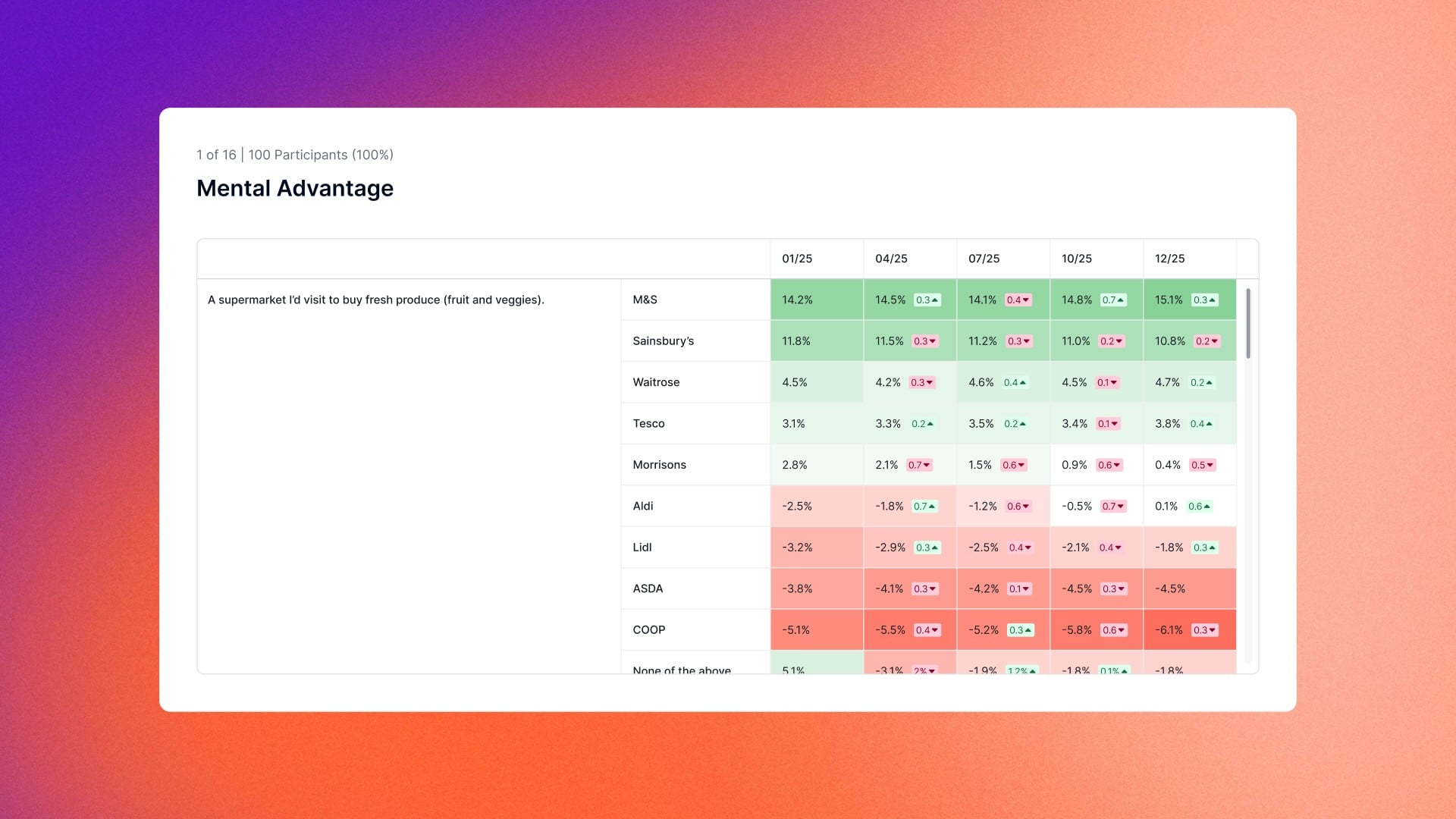
Appinio covers for example Conjoint, MaxDiff, U&A, Brand (Mental Availability) and Campaign tracking, Pricing analysis and Concept and Creative testing, which are designed and implemented by consultants who interpret them alongside you. The point is not the method list. It is that you can run an advanced method with expert support.
What to ask: If I need a conjoint or a segmentation, can I run it here, and does someone help me design it?

Which markets can you reach?
Worth checking early, because coverage and depth are different things. A provider can technically reach a market through partners and still be thin there, which shows up as slow fieldwork, poor feasibility on specific target groups, or translation quality problems.
Appinio delivers research from 190+ markets, with research consultants across Europe, North America and LATAM who know the markets they advise on.
What to ask: For the specific markets I need, is that your own panel or a partner’s? And what feasibility can you confirm for my target group there?
When another provider is the better choice
No platform wins every brief, and a shortlist that starts from that assumption gets to the right answer faster.
- A full-service institute is the better choice when you need syndicated data, established category norms, or a methodology with decades of validation behind it, and you have the budget and timeline that come with it.
- An enterprise experience management suite is the better choice when market research is one part of a wider programme spanning customer and employee experience, and you have a research operations team to run it.
- A panel provider is the better choice when you already have the research expertise in-house and simply need quality sample.
Appinio is the right choice when you want fast consumer answers from an extensive hybrid panel network (owned panel app and fully vetted, compliant panel partners), a platform your whole team can use without training, and research expertise included rather than quoted separately.
Ready to try out the Appinio platform?
to build your first survey in seconds and uncover the insights that really matter!